
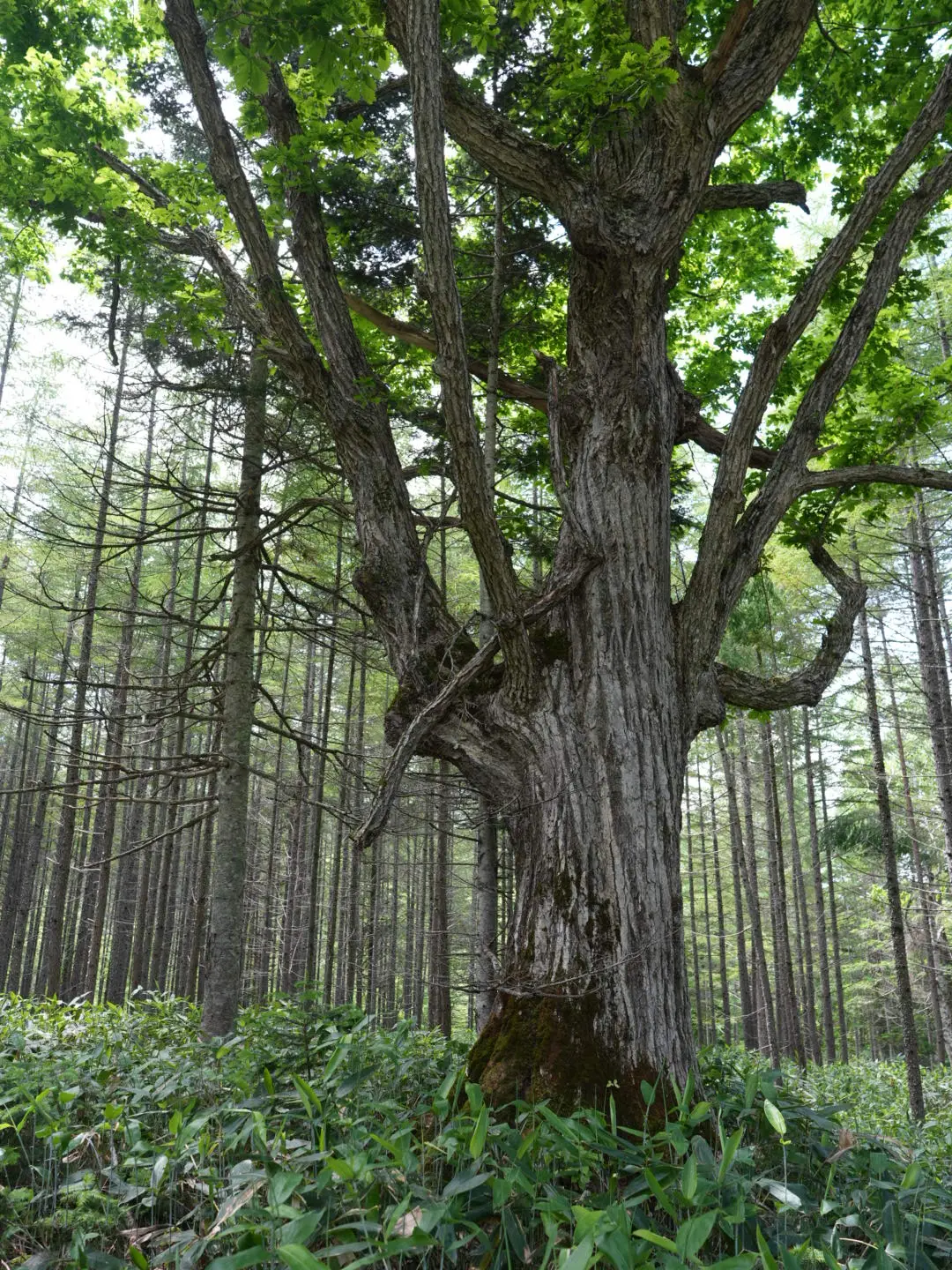
Shimokawa Town 90.6%, Dohoku over 80%, Hokkaido 71%, Japan 67%, the world 31%. Viewed across these four scales of forest coverage, Dohoku stands out as an exceptional concentration of forest within Japan. Drawing on the Forestry Agency's forest resource surveys and the prefectural government's forestry statistics, we read the past decade of change in planted forests, natural forests, FSC certification, and the forestry workforce, and lay out the key questions for the next ten years.
Shimokawa Town’s forest coverage rate is 90.6%. Even the average across Dohoku (northern Kamikawa, the Rumoi inland area, and the Soya mountains) exceeds 80%. Set against Japan’s overall 67.4% and the world average of 31%, the numbers make clear that Dohoku is “Japan’s boreal forest belt.” In this article, drawing on the public statistics of the Forestry Agency and the Hokkaido Government as well as the forest planning system, we organize how Dohoku’s forest system has changed over the past ten years along four axes (area / species composition / certification / stewardship). For comparative data on a prefecture-wide scale, see dohokuhub’s “Four-Axis Comparison of Forest Coverage Rates”, and for long-term trends in biodiversity, see dohokuhub’s “Biodiversity of Hokkaido’s Forests” as well.
1. Positioning Dohoku Across the Four Axes of Forest Coverage
| Scale | Forest coverage rate | Source |
|---|---|---|
| World average (2020) | 31.0% | FAO Global Forest Resources Assessment |
| Japan | 67.4% | Forestry Agency, Current State of Forest Resources |
| Hokkaido | 71.0% | Hokkaido Forestry Bureau Statistics |
| Dohoku (northern Kamikawa + Rumoi inland + Soya mountains) | over 80% | Forestry Agency tabulation |
| Shimokawa Town | 90.6% | Shimokawa Town Forest Development Plan |
Japan is a country with more than twice the forest stock of the world average, and within that, Dohoku holds a concentration nearly 1.5 times higher still. The image of “Dohoku = forest land” is accurate, yet even within Dohoku there is a 2.5-fold gap in forest coverage between Higashikagura Town (35.9%) at the southern edge of Kamikawa and Shimokawa Town (90.6%). The structure is one in which places where afforestation is economically viable due to geography, elevation, and climate coexist with places in the plains where farmland use takes priority.
2. Changes Over the Past Decade
2.1 Area Has Stayed Roughly Flat, but the Composition Is Shifting
The forest area itself has remained roughly flat in the public statistics, but its composition is moving. For Hokkaido as a whole, the total area of planted forest is about 1.53 million hectares and has not changed significantly over the past decade, but the area of final felling (cutting and converting to a different stand) has increased by 40% over the past five years. The transition from the silviculture stage to the final-felling and reforestation stage has begun.
2.2 Stewardship Has Fallen 30% in Twenty Years
Dohoku’s forestry output was about 12 billion yen in 2023 (accounting for more than 40% of Hokkaido’s total), but the number of forestry workers has fallen by about 30% over twenty years. The area managed per person has expanded, and the region is in a transitional period in which mechanization and longer rotation periods are advancing simultaneously. The shortage of stewards is not merely a matter of “manpower”; it is becoming a question of systemic resilience — whether each town can keep the forest plan renewal cycle (5 years / 10 years) turning (Forestry Agency, Forestry Labor Statistics).
2.3 The Spread of FSC-Certified Forests
Shimokawa Town obtained FSC certification in 2003, making it one of Japan’s earliest certified municipal forests, and it has since become a leading national model with its 60-year-cycle forest management. In Dohoku, certified forests are also spreading to municipally owned forests in Nakagawa Town, Bifuka Town, and Nayoro City. Because certified timber is directly tied to overseas markets and to the procurement standards of major domestic building-materials companies, “holding a certified forest” itself is beginning to become a source of bargaining power for a region (FSC Japan).
2.4 Deer Damage and Forest Regeneration
One thing that cannot be avoided in practically sustaining Dohoku’s forest system is damage to young trees by Ezo deer. In the Forestry Agency’s wildlife damage surveys, Hokkaido’s forests account for more than half of the nation’s wildlife damage value in many years, and bark-stripping and browsing at the silviculture stage are a leading cause of reduced reforestation yields (Forestry Agency, Forest Damage). In Shimokawa and Nakagawa, efforts to bring capture, meat processing, and distribution in-house within the region are advancing, and north by north members Asato Shibuya and Yuto Urabe are active as stewards of this cycle.
3. Four Assets That Keep the “Forest” as a System
We organize what remains for a region out of the management effort invested in a forest, by sorting it into four types of assets. The table below adapts the prefecture-wide classification laid out in dohokuhub’s “Biodiversity of Hokkaido’s Forests” to a Dohoku scale.
| Asset type | Contents | Conditions for it to remain | Situations where it is easily lost |
|---|---|---|---|
| Physical assets | FSC-certified forests, forest roads, monitoring equipment | Continuous management for 20+ years, third-party audits | Abandonment of renewal after obtaining certification |
| Human assets | Forest officers, nature guides, hunters, researchers | Cross-generational apprenticeship and secured wage levels | Shift to seasonal employment, departure of stewards |
| Relational assets | Forestry Agency, prefectural forestry research institute, universities, town councils | Regular meetings and a shared data infrastructure | Transient collaboration lasting only the subsidy program period |
| Normative assets | Forest planning system, town ordinances, settlement agreements | Resident participation and a revision cycle | Hollowing-out of higher-level plans |
Whether Dohoku’s forests endure over the long term is determined less by the trees themselves than by “how these four assets continue to be built up.” If forestry is defined narrowly as “the business of selling timber,” human assets and relational assets are the first to degrade. If it is reframed broadly as “the work of operating a forest system,” then adjacent fields such as tourism, nature-diversity data, education, activities, and meat distribution all become candidate revenue sources for forest maintenance.
4. What Will Happen in the Next Decade
Short term (through 2030):
- A peak in the felling and reforestation of planted forests that have entered the final-felling period. Maintaining the reforestation rate amid a shortage of stewards will become a management challenge for each town.
- The full-scale arrival of TNFD disclosure. Not just forestry, sawmilling, and building materials, but major companies on the procurement side will begin requiring disclosure of forest dependency, accelerating the premiumization of FSC-certified forests.
- The institutionalization of Ezo deer management. A shift toward comprehensive plans that include capture numbers, meat distribution, and steward training.
Medium term (2030–2040):
- The northward shift of tree-species zones due to climate change. Under the RCP8.5 scenario, subalpine forests rise toward the summits, narrowing the suitable habitat for boreal-type species. Predictions by the National Institute for Environmental Studies hold that the alpine vegetation of the Daisetsuzan range will lose nearly all of its suitable habitat by 2100.
- The visualization of tourism pressure. Institutional designs that manage the number of participants in forest-based activities by linking it to biodiversity indicators may begin at the municipal level.
Long term (2040–2050):
- The export of the Dohoku model. Implementation patterns specific to each town — Shimokawa Town’s 60-year cycle, Nakagawa Town’s nature-observation base, Bifuka Town’s silent forest management — could become reference models for boreal forest regions overseas.
5. nbyn’s Initiatives
north by north is a business that translates Dohoku’s nature and ways of living into “activity as a way of life.” When it comes to forests, it bundles “walking, photographing, eating, and recording” into a single experience and holds the Dohoku Activity Caravan every month, traveling around Shimokawa, Nakagawa, and Kamikawa. Forest data on its own is nothing more than numbers aimed at the masses, but as participants accumulate the experience of “the forest they walked with their own feet corresponding to the statistical figures,” abstract forest policy turns into something personal — that is nbyn’s medium-range aim.
For the latest reports for participants and the schedule for the next session, see the Magazine and Vision.
For Deeper Reading
This Dohoku-originated article is complemented by analyses at a prefecture-wide scale.
- dohokuhub “Four-Axis Comparison of Forest Coverage Rates: Dohoku Exceeds the Hokkaido Average” — comparative data for the world / Japan / Hokkaido / Dohoku / Shimokawa Town
- dohokuhub “Biodiversity of Hokkaido’s Forests and Long-Term Trends” — key questions by forest type for Shiretoko / Daisetsuzan / Akan / southern Hokkaido
- dohokuhub Issue “Conserving Nature Diversity and Ecosystem Services” — medium- and long-term issues within Hokkaido
Sources
- Forestry Agency, Current State of Forest Resources
- Forestry Agency, Current State of the Forestry Workforce
- Forestry Agency, Forest Damage
- FAO, Global Forest Resources Assessment
- Hokkaido, Forestry Bureau Statistics
- Shimokawa Town, Forest Policy
- FSC Japan, Certified Forest Data
- National Institute for Environmental Studies, Climate Change and Alpine Vegetation